Hair loss affects roughly 85% of men by age 50 and a growing number of women, yet the treatment options available today look nothing like they did even five years ago. The debate between stem cell and standard hair transplant methods has intensified as clinics worldwide report stronger graft survival rates, faster healing, and more natural density from regenerative approaches. For anyone weighing their options in 2026, understanding the real differences between these two paths is no longer optional: it’s the difference between a good result and a great one. Whether you’re exploring traditional FUE or the newer stem cell-enhanced protocols, the science behind each method should drive your decision, not marketing hype. This guide breaks down both procedures in clinical detail, compares outcomes and costs, and helps you identify which technology fits your specific hair loss pattern, budget, and expectations.
The Evolution of Hair Restoration: Standard FUE vs. Stem Cell Therapy
Hair restoration has undergone a dramatic transformation since the strip-harvesting days of the 1990s. The introduction of Follicular Unit Extraction in the early 2000s eliminated the linear scar associated with FUT (Follicular Unit Transplantation) and opened the door to minimally invasive procedures. By 2020, FUE had become the global gold standard, accounting for over 70% of all hair transplant procedures worldwide according to the International Society of Hair Restoration Surgery.
But the field didn’t stop evolving. Stem cell-enhanced transplantation, which emerged from regenerative medicine research, began entering clinical practice around 2018-2019. By 2024, multiple peer-reviewed studies confirmed that integrating stem cell therapy with follicular extraction improved graft survival rates by 15-20% compared to conventional FUE alone. The 2026 iteration of this technology is more refined, with standardized protocols now in use at accredited clinics across Europe and Turkey.
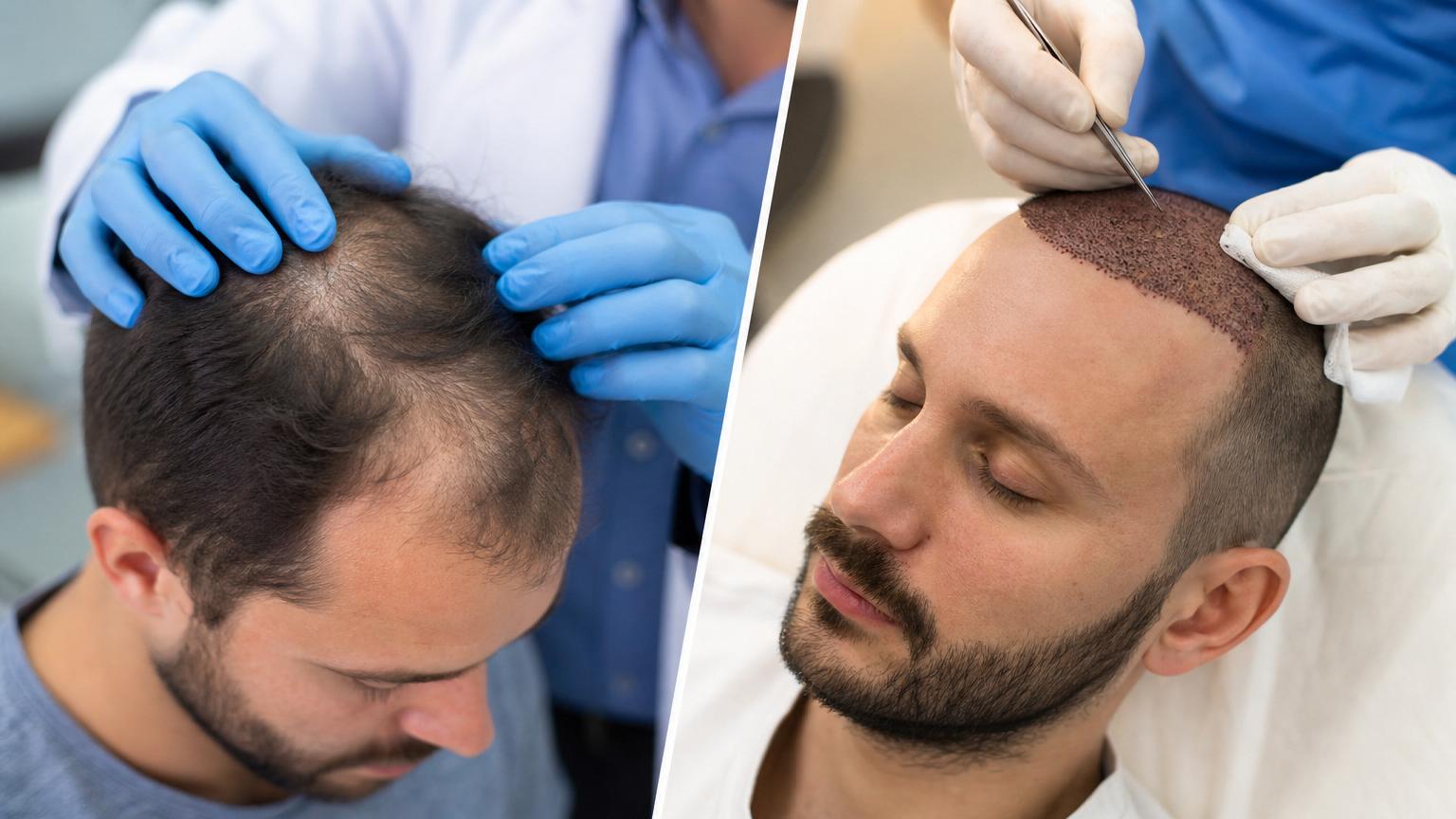
The core distinction is straightforward. Standard FUE physically relocates hair follicles from a donor area to a thinning zone. Stem cell-enhanced procedures do the same, but add a biological layer: harvested adipose or follicular stem cells are processed and reintroduced to stimulate dormant follicles and improve the micro-environment where grafts are placed. This isn’t a replacement for transplantation: it’s an amplifier.
How Traditional Follicular Unit Extraction Works
FUE remains the backbone of modern hair restoration for good reason. The procedure involves extracting individual follicular units, typically containing 1-4 hairs each, from the donor area at the back and sides of the scalp. A micro-punch tool ranging from 0.6mm to 1.0mm in diameter is used to isolate each graft, which is then stored in a chilled holding solution (usually Hypothermosol or a saline-based medium) before implantation.
The implantation phase requires the surgeon to create recipient sites using pre-made incisions at precise angles, typically between 40 and 45 degrees for the frontal hairline and 30 degrees for the crown. Graft density usually ranges from 35 to 50 follicular units per square centimeter, depending on the patient’s native hair characteristics and the area being treated.
Recovery from standard FUE follows a predictable timeline:
- Days 1-3: mild swelling, pinpoint scabbing at extraction and recipient sites
- Days 7-10: scabs fall off, redness begins to fade
- Weeks 2-4: transplanted hairs shed (a normal phase called “shock loss”)
- Months 3-4: new growth becomes visible
- Months 8-12: final density achieved, with full results typically assessed at the 12-month mark
The procedure typically takes 6-8 hours for a session of 2,500-3,500 grafts. Patients can return to desk work within 3-5 days, though strenuous exercise should be avoided for at least three weeks.
The Science Behind Stem Cell Hair Restoration
Stem cell hair restoration in 2026 builds on FUE’s mechanical precision by introducing a biological component that targets the cellular environment around each graft. The most widely adopted protocol involves harvesting a small sample of adipose (fat) tissue, usually from the abdomen or flanks, via a mini-liposuction procedure using a 2mm cannula under local anesthesia. This sample is then processed in a centrifuge to isolate the stromal vascular fraction (SVF), which contains mesenchymal stem cells, growth factors, and cytokines.
These isolated cells are injected into the recipient area before, during, or immediately after graft placement. The concentration typically ranges from 1-5 million nucleated cells per milliliter, depending on the processing method. Some clinics also use follicle-derived stem cells extracted from a small scalp biopsy, though adipose-derived SVF remains more common due to higher cell yields.
The biological mechanism works on multiple levels. Mesenchymal stem cells release paracrine signals: vascular endothelial growth factor (VEGF), platelet-derived growth factor (PDGF), and fibroblast growth factor (FGF): that promote angiogenesis (new blood vessel formation) around the transplanted grafts. This improved blood supply means better oxygen and nutrient delivery during the critical first 72 hours post-transplant, when graft survival is most vulnerable.
Research published in the Journal of Dermatological Science (2025) demonstrated that SVF-enhanced FUE procedures showed a 92% graft survival rate at 12 months, compared to 78-82% for conventional FUE. Dr. Antonella Tosti, a leading trichology researcher, has noted that the anti-inflammatory properties of mesenchymal stem cells also reduce post-operative fibrosis, which can otherwise impede follicle anchoring in the recipient zone.
A secondary benefit is the potential reactivation of miniaturized (dormant) follicles in the surrounding area. While stem cell therapy alone cannot regrow hair from completely bald scalp, it appears to thicken and revitalize follicles that are still present but producing only vellus (peach fuzz) hairs. This creates a “halo effect” of improved density beyond just the transplanted grafts.
Comparing Results, Recovery, and Long-Term Efficacy
The practical differences between these two approaches show up most clearly in three areas: visual density at 12 months, recovery speed, and the longevity of results over 3-5 years.
Visual density is where stem cell-enhanced procedures pull ahead most consistently. Because graft survival rates run 10-15 percentage points higher, patients typically achieve comparable density with fewer total grafts. A standard FUE case requiring 3,000 grafts for adequate frontal coverage might achieve the same or better results with 2,500 grafts when stem cell enhancement is used. This has a practical advantage: it preserves more of the finite donor supply for potential future sessions.
Recovery timelines also differ. Standard FUE patients generally see full healing of the donor area within 10-14 days. Stem cell-enhanced patients report similar or slightly faster healing, with some studies noting reduced redness and swelling by day 5-7 due to the anti-inflammatory properties of the injected cells. The mini-liposuction site (if adipose-derived SVF is used) adds a minor secondary recovery area, but discomfort is minimal and resolves within a week.
Long-term efficacy is the most compelling differentiator. A 2025 longitudinal study tracking 340 patients over four years found that stem cell-enhanced FUE patients retained 89% of transplanted hair density at the 48-month mark, while standard FUE patients retained 76%. The researchers attributed this gap to the sustained trophic (nourishing) effects of the stem cells on the follicular environment, which appears to slow the miniaturization process in surrounding native hairs.
One honest caveat: stem cell enhancement doesn’t eliminate the need for medical maintenance. Patients still benefit from finasteride, minoxidil, or low-level laser therapy to protect non-transplanted native hair from ongoing androgenetic alopecia. No transplant method, regardless of how advanced, addresses the underlying hormonal mechanism driving pattern hair loss.
Regenerative Potential and Future Outlook for 2026
The regenerative medicine field is moving fast. As of 2026, several developments are reshaping what’s possible in stem cell hair restoration.
Exosome therapy, which uses the signaling vesicles secreted by stem cells rather than the cells themselves, has entered clinical trials at multiple centers. Early data from a 120-patient trial at Seoul National University Hospital suggests that exosome injections alone (without transplantation) can increase hair count by 17-22% in areas of early thinning. This could eventually serve as a standalone treatment for Norwood 2-3 patients who aren’t ready for surgery.
Hair follicle cloning, or follicle neogenesis, remains the holy grail. Japanese researchers at RIKEN Institute have successfully multiplied dermal papilla cells in vitro and generated new follicles in animal models. Human trials are expected to begin in 2027-2028. If successful, this would eliminate the donor supply limitation entirely, but clinical availability is likely still 5-7 years away.
For patients making decisions right now, the best hair transplant technology available combines proven FUE mechanics with stem cell enhancement. The evidence base is strong enough in 2026 to consider SVF-enhanced FUE a validated clinical approach rather than an experimental one. The Global Hair Restoration Market, valued at $12.1 billion in 2025, reflects this shift: stem cell-enhanced procedures now represent approximately 28% of all surgical hair restoration cases performed at accredited international clinics.
Choosing the Best Hair Transplant Technology for Your Needs
Selecting the right procedure depends on several personal factors that no article can fully assess for you. Your Norwood or Ludwig classification, donor hair density, hair caliber, scalp laxity, age, and rate of progression all influence which approach delivers the best return.
Standard FUE remains an excellent choice for patients with stable hair loss (meaning little change over the past 2-3 years), adequate donor density (above 80 follicular units per square centimeter in the safe donor zone), and realistic expectations. It’s a well-understood procedure with a 20-year track record and tens of thousands of documented cases.
Stem cell-enhanced FUE makes the strongest case for patients who:
- Have limited donor supply and need maximum graft survival from every follicle
- Are in earlier stages of hair loss (Norwood 3-4) where reactivation of miniaturized follicles could add meaningful density
- Want to minimize the total number of grafts used per session to preserve donor reserves for future procedures
- Are willing to invest in a higher upfront cost for potentially superior long-term retention
Patients with advanced hair loss (Norwood 6-7) should approach stem cell claims with caution. No amount of stem cell therapy can regenerate follicles from completely bald, smooth scalp. In these cases, standard FUE with realistic graft distribution often produces the most honest results.
Cost and Accessibility of Stem Cell FUE in Turkey
Turkey has cemented its position as the global leader in hair transplant volume, performing an estimated 750,000 procedures annually as of 2025. The country’s medical tourism infrastructure, particularly in Istanbul’s Şişli and Ataşehir districts, is built around international patients, with clinics offering airport transfers, multilingual coordinators, and hotel-inclusive packages.
Standard FUE in Turkey typically costs between $1,800 and $4,500 for a full session, depending on graft count and clinic accreditation. Stem cell FUE in Turkey runs higher, generally $3,500 to $7,000, reflecting the additional laboratory processing, equipment, and expertise required for SVF preparation.
For context, the same stem cell-enhanced procedure costs $12,000-$25,000 in the United States and $8,000-$15,000 in the United Kingdom. The price difference isn’t a quality gap: it reflects Turkey’s lower operating costs, high procedure volume, and intense market competition.
Vetting a clinic properly matters more than finding the lowest price. Key questions to ask any facility:
- Is the lead surgeon personally performing the extraction and implantation, or are technicians handling critical steps? (This addresses the well-documented “ghost surgery” concern in Turkish clinics.)
- What is the stem cell processing method: enzymatic digestion or mechanical disruption? (Enzymatic methods yield higher cell counts but require more sophisticated lab equipment.)
- Can the clinic provide before-and-after documentation from patients at 12+ months, not just 3-6 months?
- Is the facility accredited by Turkey’s Ministry of Health and JCI (Joint Commission International)?
Clinics like Estenove, which operate in Istanbul with dedicated stem cell processing labs and surgeon-led procedures, represent the tier of facility where these protocols are executed with proper oversight. The difference between a $2,000 procedure and a $5,000 one often comes down to who is actually holding the punch tool and whether the stem cell preparation follows validated laboratory standards.
Key Considerations for Selecting the Right Procedure
The choice between standard and stem cell-enhanced hair transplantation isn’t binary: it’s a spectrum of trade-offs that should be discussed with a qualified surgeon who has no financial incentive to push one method over the other.
Start by getting an independent assessment of your hair loss stage and donor capacity. Request a trichoscopy exam, which uses a digital microscope to measure follicular density, hair shaft diameter, and miniaturization ratio in both donor and recipient zones. These numbers should drive the recommendation, not a sales consultation.
Track your own progress objectively. Take monthly photos of your hairline and part under consistent overhead lighting, using the same camera distance and angle each time. This creates an honest visual record that cuts through subjective perception.
If you’re considering a stem cell-enhanced procedure, ask for published evidence supporting the specific protocol the clinic uses. Not all “stem cell” treatments are equal: PRP (platelet-rich plasma) is sometimes marketed as stem cell therapy, but it contains growth factors without actual stem cells. True SVF or follicle-derived stem cell protocols involve tissue harvesting and laboratory processing that PRP does not.
The gap between stem cell and standard hair transplant outcomes is real but not miraculous. Expect a meaningful improvement in graft survival and surrounding hair quality, not a complete reversal of advanced baldness. Patients who enter the process with calibrated expectations and a maintenance plan (medical therapy, follow-up sessions as needed) consistently report the highest satisfaction rates: above 90% at 24 months, according to 2025 ISHRS survey data.
Your hair is a finite resource. Whichever method you choose, the goal is the same: maximize every graft, protect what remains, and plan for the long term.